

Screening

screening for malnutrition and sarcopenia

Screening

This page has links to easy access resources to support the implementation of the screening recommendations in the COSA Cancer-related Malnutrition and Sarcopenia Position Statement.

Which screening tools to use

Position Statement Recommendation

All people with cancer should be screened for malnutrition in all healthcare settings at diagnosis and repeated as the clinical situation changes, using a screening tool that is valid and reliable in the setting in which it is intended.

Screening for malnutrition can be bypassed for people with a cancer diagnosis or treatment plan known to lead to high risk of malnutrition (see Table 1).

Table 1. Factors indicative of high risk of malnutrition
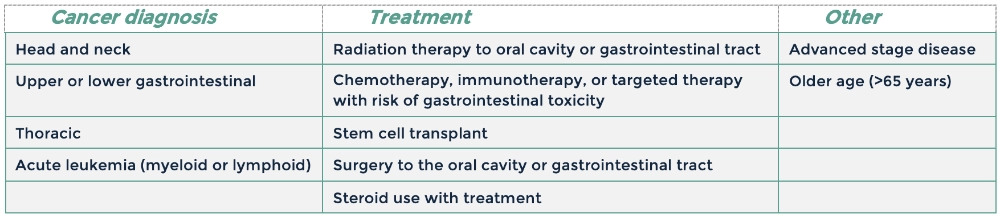
table of factors indicating high risk of malnutrition

The following malnutrition screening tools have been shown to be valid and reliable for identifying malnutrition in people with cancer. The table below summarises the settings in which each screening tool has been validated.

Table 2. Malnutrition screening tools
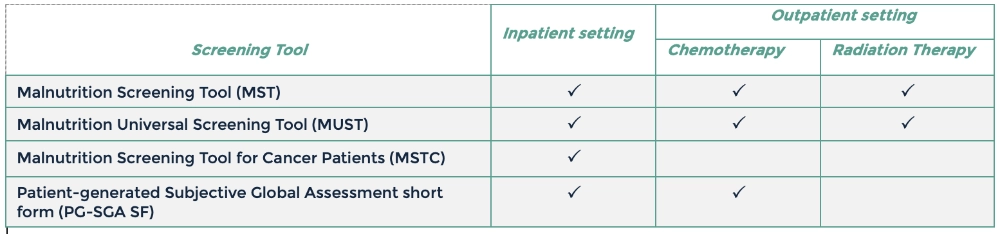
table of malnutrition screening tools

Malnutrition Screeening Tool (MST)

The MST is commonly used in Australia and can be self-administered or completed by any health professional. The MST is 2 questions, takes ~30 seconds to administer and is a good choice for large volume screening and where time is an issue.

Downloadable PDF
Online Interactive MST – available in 10 languages
Publication

The MUST is a 5-step tool that can be completed by any health professional. It takes ~ 5 minutes to administer and may be a good choice for smaller volume screening and triaging into specialist clinics.

Downloadable PDF
Online MUST calculator
Publication

The PG-SGA SF is designed to be completed by the patient and scored by a health professional and takes a few minutes to complete.

Downloadable PDF
Online PG-SGA – available in ~20 languages
Publication

Position Statement Recommendation

All people with cancer should be screened for sarcopenia at diagnosis and repeated as the clinical situation changes, using the validated screening tool SARC-F or SARC-F in combination with calf-circumference.

The SARC-F has recently been validated for use in people with cancer, either alone or in combination with measurement of calf circumference.

The sensitivity and specificity of the SARC-F plus calf circumference is not very high (55.1%, 76.4%, respectively) in people with cancer (Fu et al, 2020). This means as a screening tool it will falsely identify around 45% of people as ‘at risk’ and miss about 25% of people who are ‘at risk.’ The SARC-F used on its own has an even lower sensitivity (22.4%) but high specificity (92.1%) meaning it will incorrectly classify a high proportion (~78%) of people as ‘at risk’ but is good at identifying who is not ‘at risk’ (Fu et al, 2020).

There are no tools currently available with both high sensitivity and specificity, therefore the SARC-F with or without calf circumference may be used but health professionals should be aware of the limitations.

Strength, Ambulation, Rising from a chair, stair Climbing and history of Falling (SARC-F)

Exemplars of evidence-based care in practice

The following case studies have been developed as exemplars of evidence-based care in practice. It is hoped they will help to support the implementation of the position statement recommendations into practice.

Incorporating malnutrition or sarcopenia screening into existing supportive care screening processes
Improving your model of care to ensure timely identification of sarcopenia
Implementing self-screening for malnutrition risk
Improving completion rates for malnutrition screening

Scroll to Top