Transitions of Care

Transitions of Care
This page provides resources to support the transition of care of people with cancer-related malnutrition and sarcopenia between care providers.
What are transitions of care?
Transitions of care are time-points when care is transferred between care providers. Transitions of care may occur within and between healthcare locations, settings, care delivery types, levels of care and involve a range of health care providers. For example:
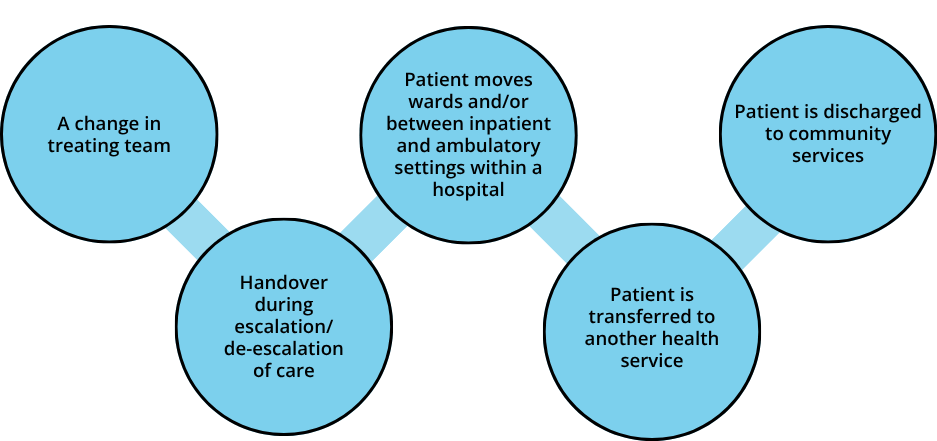
How to ensure safe and high-quality transitions of care?

Person-centered
- Transitions of care should be based on shared decision making and informed consent.
- Communication with the patient and/or their family should be open, honest and respectful, and provide opportunity for clarification and feedback.

Plan for transitions of care early
- Discuss the plan for ongoing care with the patient and/or their family
from day one of admission and/or change of setting, treatment and/or clinical situation. - Ensure there is multidisciplinary collaboration to support transitions of care.

Documentation
- Ensure malnutrition and/or sarcopenia diagnosis is included in all relevant documentation in the medical history and handover documents, including medical discharge summary.
- Include current and future goals/management plans in handover documents.

Communication
- In effective patient-clinician communication, information is exchanged between the patient and their healthcare provider and includes communication with the family or carer.
- At transitions of care, communication should be timely and handover should be both verbal and written.
- Ensure comprehensive documentation about the patients’ previous and ongoing care:
- The ISBAR format should be used to aid communication.
- Using ISBAR ensures a minimum dataset of information is discussed and improves efficiency and effectiveness of handover.
- Consider the use of handheld records for the patient
- Macmillan Cancer Support – My records
- AHCP Template – After Hospital Care Plan

Understand referral pathways
- Understand local cancer services available in primary and community care to ensure continuity of care post discharge or at the completion of treatment.
- Articulate escalation pathways back into the treating cancer service if specialist care/monitoring is required.
- Refer to the Options for the Care of Cancer-related Malnutrition and Sarcopenia fact sheet

Cross-sector collaboration
- Ensure coordination and continuity of care by outlining responsibility and accountability between the treating and receiving service.
- Consider utilising telehealth or other digital solutions to support transitions of care.
- Shared care models can be used to support transition to/from metropolitan and regional health services or to/from acute and primary care health services.
Fact sheets
How to Ensure Effective Transitions of Care (includes the ISBAR communication framework)
Options for the Care of Cancer-related Malnutrition and Sarcopenia
Exemplars of evidence-based care in practice
The following case studies have been developed as exemplars of evidence-based care in practice. It is hoped they will help to support the implementation of the position statement recommendations into practice.
Shared care to support care transitions
CanEAT pathway – Decision support tools