Treatment


Treatment
Evidence-based resources to support implementation of the treatment recommendations in the COSA Cancer-related Malnutrition and Sarcopenia Position Statement.
Position statement recommendations
All people with cancer-related malnutrition and sarcopenia should have access to the core components of treatment including individualised medical nutrition therapy, targeted exercise prescription and physical activity advice, and physical and psychological symptom management.
Treatment for cancer-related malnutrition and sarcopenia should be individualised, in collaboration with the MDT, and tailored to consider multi-morbidities and meet needs at each stage of cancer treatment.
Core components of treatment of cancer-related malnutrition and sarcopenia
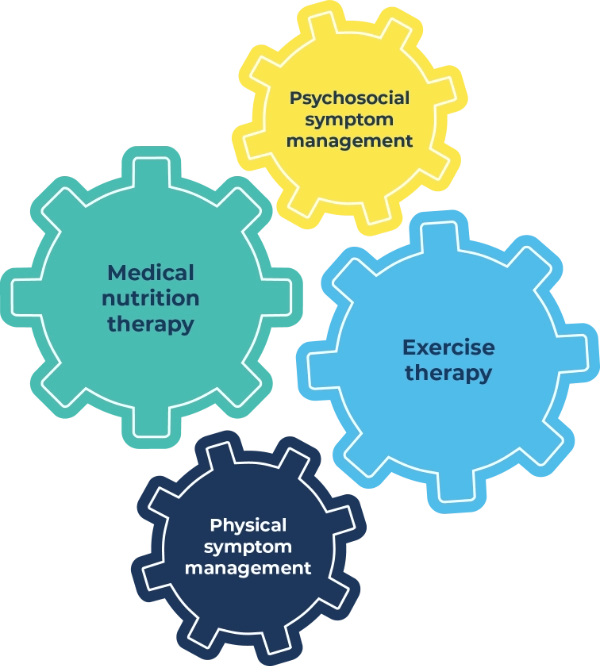
Patients who are at risk of malnutrition or sarcopenia or diagnosed with malnutrition or sarcopenia should be referred to a dietitian and physiotherapist/exercise physiologist for nutrition and exercise therapy. They should also have support from the multidisciplinary team to identify and manage any physical or psychosocial symptoms. However, not all health services will be able to accommodate this. If you don’t have access to the appropriate support services, the resources below can be used to support your patient.
Medical Nutrition Therapy
Nutrition interventions are most beneficial when they are proactive, initiated early, and continued through recovery, preferably as part of multimodal interventions that also include exercise therapy.
All patients should have a comprehensive assessment and receive individualised nutrition counselling and support to manage nutrition impact symptoms and optimise dietary intake. If nutrition support is required, the route will vary according to the clinical situation, but may include oral nutrition supplements, enteral nutrition or parenteral nutrition. Advice relating to the nutrition prescription for cancer-related malnutrition and sarcopenia can be found below.
Treating or preventing malnutrition
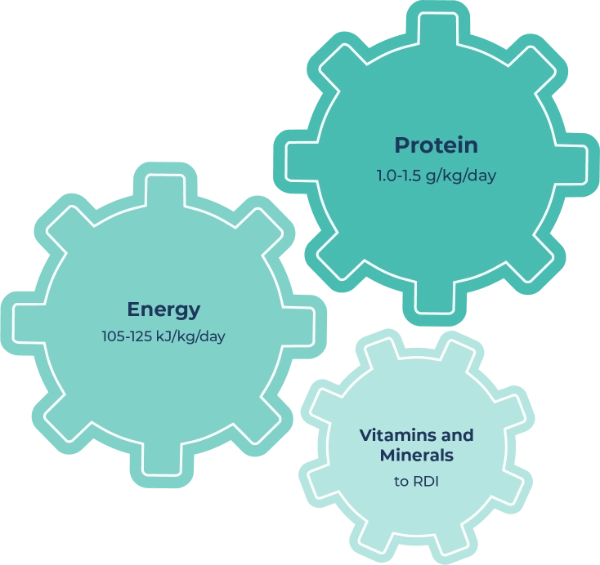
Important nutrients to consider:
Energy
- Aim for a minimum of 105kJ/kg/d – 125kJ/kg/day (Muscaritoli et al, 2021)
Protein
- Aim for a minimum of 1.0 to 1.5 grams/kg/day in protein. (Muscaritoli et al, 2021)
Vitamins and minerals
- Vitamins and minerals should be supplied in accordance with the recommended daily allowance. The use of high dose micronutrients should be discouraged in the absence of specific deficiencies. (Muscaritoli et al, 2021)
Treating or preventing low muscle mass
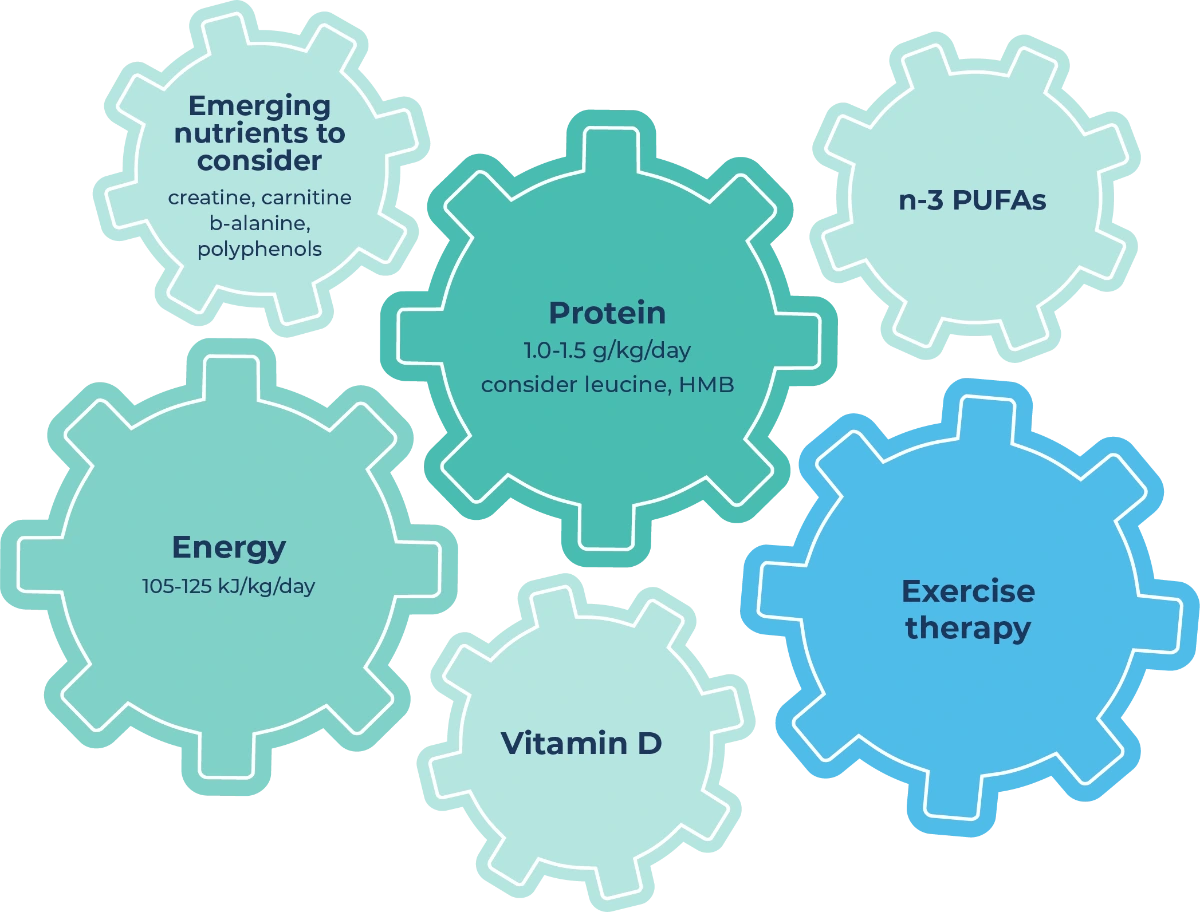
Important nutrients to consider:
Energy
- Aim for a minimum of 105kJ/kg/d – 125kJ/kg/day (Muscaritoli et al, 2021).
Protein and amino acids
- Aim for a minimum of 1.0 to 1.5 grams/kg/day in protein (Muscaritoli et al, 2021). There is emerging research investigating the benefit of higher protein intakes to support muscle protein synthesis (Ford et al, 2024; Bauer et al, 2019).
- Leucine is a branched-chain amino acid that has been shown to support increased muscle protein synthesis (Prado et al, 2022).
- b-hydroxy-b-methylbutyrate (HMB) is a metabolite of leucine that stimulates muscle protein synthesis and inhibits muscle protein breakdown (Prado et al, 2022).
Vitamin D
- A fat-soluble vitamin that plays an important role in bone and muscle health (Prado et al, 2022).
n-3 PUFAs
- The anti-inflammatory effect of n-3 polyunsaturated fatty acids have been shown to promote muscle anabolism (Muscaritoli et al, 2021; Prado et al, 2022).
Other emerging nutrients for consideration include creatine, carnitine, b-alanine, polyphenols for their positive effects on muscle anabolism, muscle strength and muscle function (Prado et al, 2022).
Other considerations:
Exercise Therapy
- For medical nutrition therapy to be optimally effective, it needs to occur alongside exercise intervention Bauer et al, 2019).
Relevant evidence-based guidelines
- ESPEN guidelines on nutrition in cancer patients 2021
- Academy of Nutrition and Dietetics (AND) oncology evidence-based nutrition practice guideline 2017
- ASPEN Clinical Guidelines: Nutrition Support Therapy During Adult Anticancer Treatment and in Hematopoietic Cell Transplantation 2009
- COSA position statement on cancer-related malnutrition and sarcopenia 2021
- Sarcopenia: A Time for Action, An SWCD Position Paper 2019
Professional Development Resources for Health Professionals
What resources can I give my patient about nutrition and cancer?
- Nutrition and cancer – Cancer Council
- Preventing weight loss – Why is it important for people with cancer? – VCMC
- Muscle Loss and Cancer Treatments – Dietitian Connection
- Getting the right amount of protein – NEMO
- The CanEAT pathway: a guide to optimal cancer nutrition for people with cancer, carers and health professionals – VCMC
Exercise Therapy
Exercise training complements nutrition interventions in the treatment of cancer-related malnutrition and sarcopenia. Specifically, targeted exercise interventions promote improvements in muscular strength, physical function, and body composition including the preservation or accumulation of lean mass independent of changes in body weight. An individually prescribed multimodal exercise program (including targeted aerobic, resistance, and balance training) at moderate to high intensity is recommended. In individuals with or at risk of sarcopenia, interventions should emphasise resistance exercise incorporating exercises for major muscle groups.
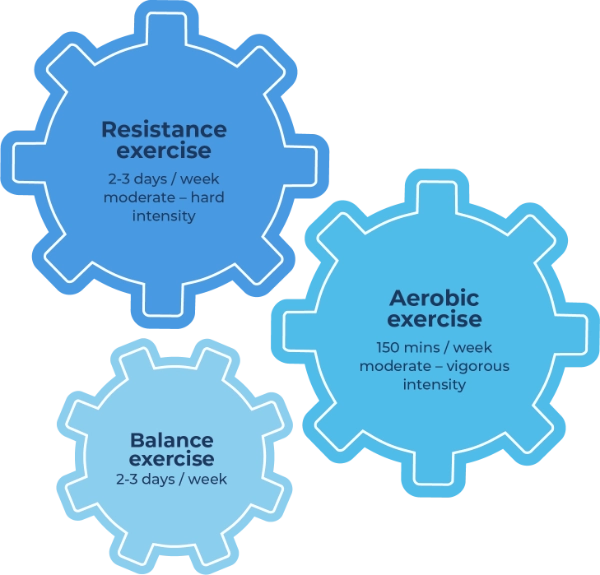
The Exercise and Sports Science Australia (ESSA) position statement provides valuable guidance in the prescription of exercise in cancer management (Hayes et al, 2019). The recommended approach, summarised in Figure 1, should be considered by clinicians endorsing or delivering exercise to patients with or at risk of sarcopenia and malnutrition. Optimal Exercise prescription will be determined by patient assessment, identification and consideration of general and cancer-specific health issues and their contribution to risk of morbidity and/or mortality, and subsequent patient-driven goals. Individualised exercise prescription, which includes the provision of behaviour change advice and support, is needed to ensure greatest benefit.
Key components of exercise therapy
Resistance exercise
- Resistance exercise promotes improvements in muscular strength, muscle hypertrophy, bone health and physical function. Examples include exercises using body weight, resistance bands, machine weights, and free weights.
- 2-3 sessions/week, involving 2-3 sets of exercises for each major muscle group at moderate to hard intensity is safe and recommended for most patients (Hayes et al, 2019; COSA 2017).
Aerobic exercise
- Aerobic exercise promotes improvements in cardiorespiratory fitness, exercise tolerance, and cardiometabolic health. Examples include walking, cycling, rowing, dancing, and swimming.
- 150 minutes accrued over 5-7 days/week at moderate (40-59% heart rate reserve) to vigorous (60-89% heart rate reserve) intensity is safe and recommended for most patients (Hayes et al, 2019; COSA 2017).
Balance exercise
- Balance exercise reduces the risk of falls and promotes improvements in/maintenance of physical function and independence. Examples include exercises challenging balance, agility, coordination, gait and proprioception.
- 2-3 sessions of 20-30 minutes/week per week is safe and recommended for most patients (Hayes et al, 2019) .
Exercise prescription and progression should align with patient goals, symptom burden, physical capacity, and health history and may evolve as these change across the cancer treatment trajectory.
Relevant evidence-based guidelines
- Exercise and Sports Science Australia (ESSA) position statement: exercise medicine in cancer management 2019
- American College of Sports Medicine (ACSM) Exercise Guidelines for Cancer Survivors 2019
- American Cancer Society – Guidelines on exercise is medicine in oncology: Engaging clinicians to help patients move through cancer 2019
- COSA position statement on exercise in cancer care 2021
- Exercise Recommendation for People with Bone Metastases: Expert Consensus for Health Care Providers and Exercise Professionals 2022
Professional Development Resources for Health Professionals
- Cancer Exercise Toolkit
- Exercise Prescription and Modification Considerations – Cancer Exercise Toolkit
- Integrating physical activity into cancer care – MacMillan Cancer Support
- Moving through cancer infographic – University of British Columbia
- The science of exercise for cancer – Dr Kerry Courneya
- Exercise is Medicine tools – Exercise & Sports Science Australia
What advice can I give to my patient about exercise and cancer?
- Exercise and cancer – Cancer Council
- Exercise Videos – Cancer Council
- Exercise and Cancer – Exercise & Sports Sciences Australia
- Being active when you have cancer – Exercise is Medicine
- Fitness and strength exercises | Prep 4 Cancer Surgery – Prep 4 Cancer Surgery
- Exercise Guides – Penn State University Oncology Nutrition Education Group
- Exercise Videos – Penn State University Oncology Nutrition Education Group
- Coping with cancer: Exercise support – BC Cancer
- Being physically active when you have bone metastases – Canadian Cancer Society
- Exercise and myeloma – Myeloma Australia
Physical Symptom Management
The multidisciplinary team should take a coordinated approach to assessing and managing physical symptoms that may compromise a patient’s nutritional intake and capacity for physical activity.
Relevant evidence-based guidelines
How can I support my patients to manage their cancer-related side-effects?
- Loss of appetite – NEMO
- Nausea and Vomiting – NEMO
- Cancer Therapy and Nausea – MASCC
- Taste and Smell – Cancer Council
- Understanding Mouth Health and Cancer Treatment – Cancer Council
- Cancer Therapy and Mouth Sores – MASCC
- Painful Eating and Swallowing – NEMO
- Diarrhoea during cancer treatment – eviQ
- Constipation during cancer treatment – eviQ
- Understanding Fatigue and Cancer– Cancer Council
- The CanEAT pathway: a guide to optimal cancer nutrition for people with cancer, carers and health professionals – VCMC
Psychosocial Symptom Management
The multidisciplinary team should take a coordinated approach to assessing and managing psychosocial symptoms that may compromise a patient’s nutritional intake and capacity for physical activity.
Relevant evidence-based guidelines
How can I support my patient to manage their psychosocial health?
- Psychological support – Cancer Council
- Emotions and Cancer – Cancer Council
- Exploring ways to look after your mind when you are affected by cancer – Cancer Mind Care
Common Questions
When is it not safe for my patient to exercise?
- Exercise safety – Prep 4 Cancer Surgery
- Exercise-Prescription-and-Modification-Considerations – Cancer Exercise Toolkit
- Exercise Recommendation for People with Bone Metastases: Expert Consensus for Health Care Providers and Exercise Professionals – ASCO
What advice can I give to my patient about common cancer related misinformation?
- iHeard – Mission Against Health Misinformation – Cancer Council
- Nutrition and Cancer: 12 top myths busted – VCMC
What advice can I give my patient about cancer prevention?
- Preventing cancer – World Cancer Research Fund
- Lifestyle Medicine Toolkit for Cancer Risk Reduction & Survivorship – American College of Lifestyle Medicine
- Diet | Cancer Australia – Cancer Australia
What advice can I give my patient about living well after cancer?
- Living well after cancer – Cancer Council
- Living with and beyond cancer – Australian Cancer Survivorship Centre
Exemplars of evidence-based care in practice
The following case studies have been developed as exemplars of evidence-based care in practice. It is hoped they will help to support the implementation of the position statement recommendations into practice.
Eating as treatment (EAT) study
Nutrition care pathway for upper GI cancer surgery
Structured exercise after adjuvant chemotherapy for colon cancer (CHALLENGE study)
The effect of early nutrition support on malnourished medical patients (EFFORT trial)