

Assessment
Assessment
This page has links to easy access resources to support the implementation of assessment recommendations in the COSA Cancer-related Malnutrition and Sarcopenia Position Statement.
Diagnostic Criteria
Position Statement Recommendation
All people with cancer identified as being ‘at risk’ of malnutrition following appropriate screening or with a cancer diagnosis or treatment plan known to lead to high risk of malnutrition should have comprehensive nutrition assessment using a tool validated in the oncology population.
Diagnostic Criteria
Patient-Generated Subjective Global Assessment (PG-SGA)
The Patient-Generated Subjective Global Assessment (PG-SGA) is a validated assessment tool that aligns with GLIM criteria for diagnosing malnutrition and can be used to assess and diagnose malnutrition in people with cancer.
Subjective Global Assessment (SGA)
The Subjective Global Assessment (SGA) is a validated assessment tool that aligns with GLIM criteria for diagnosing malnutrition and can be used to assess and diagnose malnutrition in people with cancer.
Global Leadership initiative on Malnutrition (GLIM)
The Global Leadership Initiative on Malnutrition (GLIM) produced a consensus statement in 2019 outlining the recommended assessment domains for a diagnosis of malnutrition. For a diagnosis of malnutrition, at least 1 phenotypic and 1 etiologic criteria must be present.
GLIM diagnostic criteria for malnutrition

GLIM Fact Sheets
GLIM criteria for the diagnosis of malnutrition
Guidance for assessment of muscle mass phenotypic criterion
Guidance for assessment of the inflammation etiologic criterion
Position Statement Recommendation
All people with cancer identified as being ‘at risk’ of sarcopenia following appropriate screening should have a comprehensive evaluation of muscle status using a combination of assessments for muscle mass, muscle strength and function.
Interpretation of diagnostic criteria for sarcopenia should be applied recognising that:
- Threshold values for assessing muscle mass, muscle strength and physical performance are variable.
- Care should be taken to determine the appropriate cut-off values in the population in which they are being applied.
- Most data regarding muscle strength and performance comes from older populations.
- The applicability of diagnostic criteria in different ethnicities is uncertain.
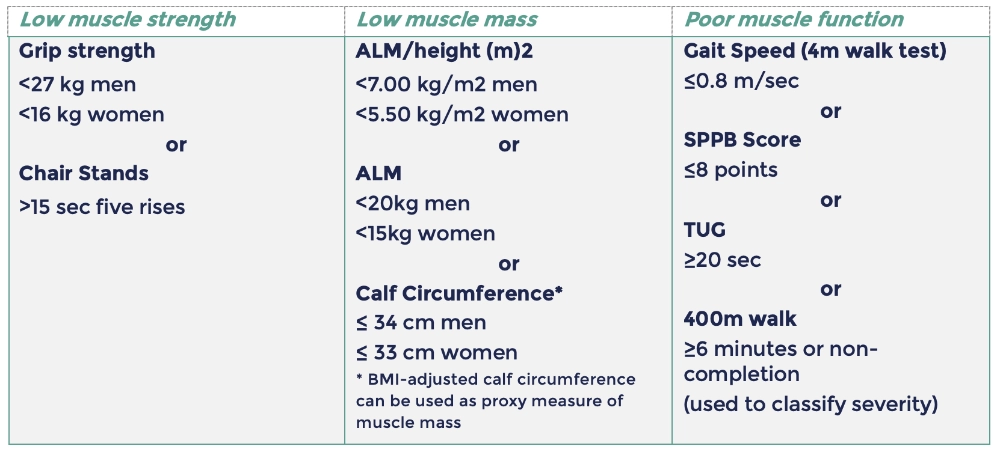
There is no global consensus on the diagnostic criteria for sarcopenia. Commonly used definitions are included below.
European Working Group on Sarcopenia in Older People updated definition (EWGSOP2)
European Working Group on Sarcopenia in Older People (EWGSOP1)

Foundation for the National Institutes of Health biomarkers consortium sarcopenia project (FNIH)

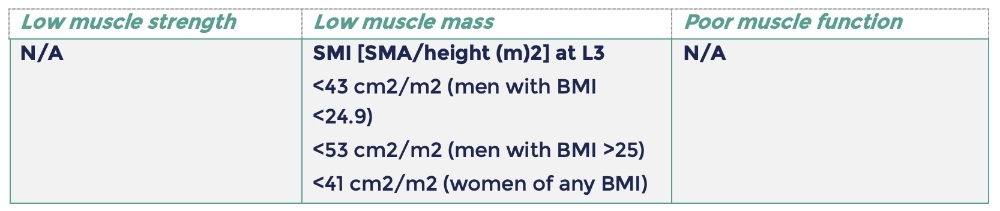
Cancer specific CT image analysis
Cancer-specific CT image analysis research diagnostic criteria for sarcopenia

How to complete assessment
Provided below are a battery of assessment tools/measures. Please choose the assessment tools/measures appropriate to your local context.
The Patient-Generated Subjective Global Assessment (PG-SGA) and Subjective Global Assessment (SGA) are validated assessment tools that can be used to assess and diagnose malnutrition in people with cancer.
Patient-Generated Subjective Global Assessment (PG-SGA)
The Patient-Generated Subjective Global Assessment (PG-SGA) is a validated assessment tool that can be used to assess and diagnose malnutrition in people with cancer.
PG-SGA How to Guide
PG-SGA Instructional Video available soon!
Subjective Global Assessment (SGA)
The Subjective Global Assessment (SGA) is a validated assessment tool that can be used to assess and diagnose malnutrition in people with cancer.
The Subjective Global Assessment (SGA) and Patient-Generated Subjective Global Assessment (PG-SGA) include a physical examination component that assesses muscle mass and function.
PG-SGA physical exam
The PG-SGA physical exam can be used to assess muscle mass.
PG-SGA Physical Examination How to Guide
PG-SGA Physical Examimation Instructional Video – available soon.
Calf Circumference
Calf circumference can be used as a marker of muscle mass in clinical practice.
Calf Circumference How to Guide
Calf Circumference Instructional Video
Biolectric Impedance Analysis
BIA uses the resistance to a single frequency electrical current (impedance) to estimate fat-free mass.
Bioelectric Impedance Analysis How to Guide
Bioelectric Impedance Analysis Instructional Videos 1 and 2
Bioelectric Impedance Spectroscopy
BIS uses the resistance to a multiple frequency electrical current (impedance) to estimate fat-free mass.
Bioelectric Impedance Spectroscopy How to Guide
Bioelectric Impedance Spectroscopy video
Handgrip Strength
Hand grip strength is used as a measure of muscle strength.
Handgrip Strength How to Guide
Handgrip Strength Instructional Videos 1 and 2
Chair Stand Test
The chair stand test, also known as the 5 times sit to stand, can be used as a measure of muscle strength.
Chair Stand Test How to Guide
Chair Stand Test Instructional Video
Short Physical Performance Battery
The SPPB is an objective measure of balance, lower extremity strength and functional capacity in older adults.
Short Physical Performance Battery How to Guide
Short Physical Performance Battery Instructional Video 1
Timed Up and Go
The timed up and go is used to assess mobility, balance, walking ability and fall risk in adults 65 years and over.
Timed Up and Go How to Guide
Timed Up and Go Instructional Videos 1 and 2
Gait Speed Test
The gait speed test, also known as the 4m walk test, assesses an individual’s functional mobility.
Gait Speed Test How to Guide
Gait Speed Test Instructional Video
400m Walk Test
The 400m walk test can be used to classify the severity of sarcopenia in the context of physical function and mobility.
400m Walk Test How to Guide
400m Walk Test Instructional Video
Exemplars of evidence-based care in practice
The following case studies have been developed as exemplars of evidence-based care in practice. It is hoped they will help to support the implementation of the position statement recommendations into practice.
Assessment of skeletal muscle via CT
How to train clinicians in new assessment measures


